
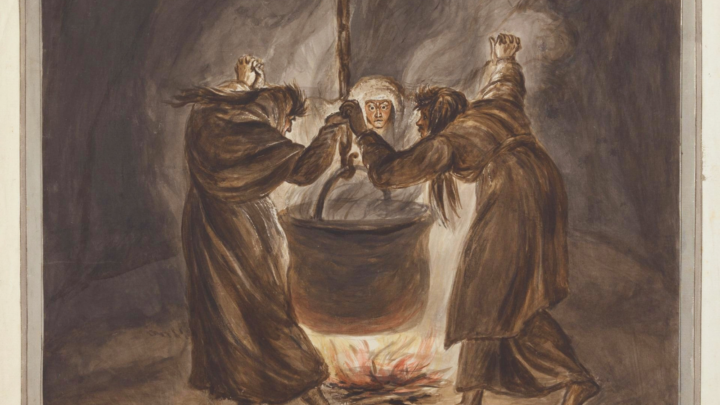
A few hundred years ago, a village woman knew which herbs could help the sick, and neighbors knocked on her door when something went wrong. For most of her life, this knowledge made her useful. But if a cure failed, or a neighbor fell out with her, that very same knowledge could make her a suspect.
This is one of the threads that runs through the history of witchcraft, and plants sit right at the centre of it. In ancient Greece, a single word, pharmakon, could mean a drug used for curing, a drug used for poisoning, or the magical knowledge of how to use them. Over time, a related word, pharmakis, came to mean a wise woman, or a witch. The person who knew plants held real power. And power in the hands of women often made people uneasy.
During the witch trials in Europe, many of the people accused were women. Some were healers. Others were simply poor, old, or on bad terms with a neighbour. Many of the stories about witches’ brews and poisonous ointments did not come from the accused at all. They came from the demonologists, judges and inquisitors who questioned them.
I will not talk about the myths of evil witches stirring cauldrons. This is about plants, and the stories people tell about them. Some of these stories come from ancient myths. Some come from folk customs meant to protect homes and harvests. Some come from court records, where ordinary herbs ended up as evidence. And many of them show how thin the line was between a healer and a witch. Often, it depended only on who was telling the story.
Herbs of myth
The oldest witch stories in Western culture come from ancient Greece and Rome, and herbs appear in them again and again.
The first is Medea. In the Greek legend, the hero Jason arrives in the kingdom of Medea’s father to claim the Golden Fleece. Her father sets Jason a series of impossible tasks. Medea falls for Jason and helps him succeed, using magical herbs and spells.
Later, Jason asks her to extend the life of his elderly father. At the full moon, Medea walks barefoot to a sacred grove at midnight and prays to Hecate, goddess of the underworld. Then she flies through the night sky in a chariot drawn by winged dragons, gathering herbs. Back home, she puts them into a bubbling cauldron, replaces the old man’s blood with her herbal mixture, and he becomes young again.
In this version, Medea uses her knowledge to heal and to give life. Even so, later writers were more interested in her as a figure of fear. The Roman playwright Seneca turned her into an evil witch who cursed her enemies with potions from her cauldron. Over time, that darker picture became the one people remembered.
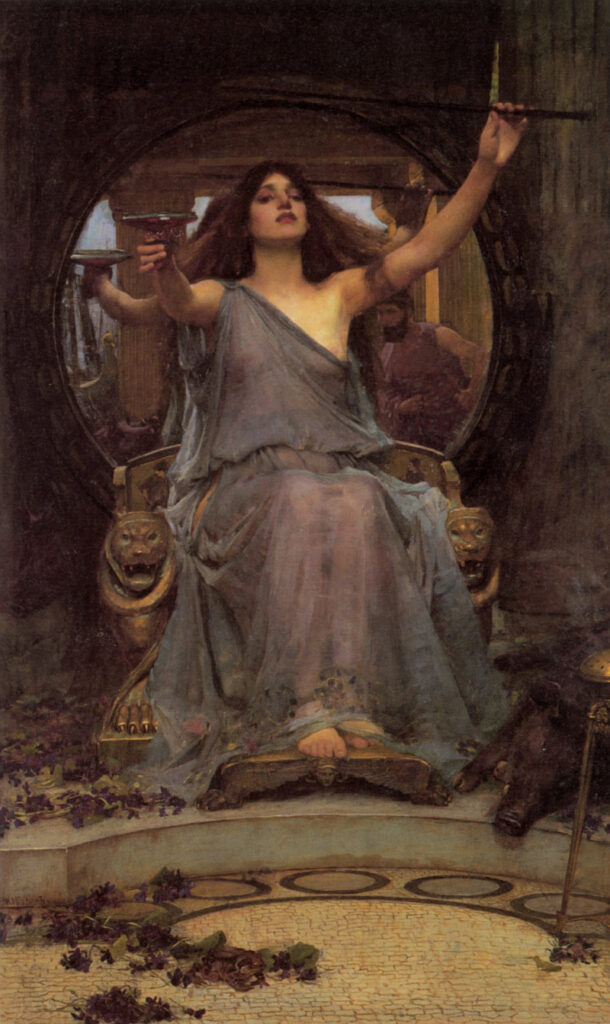
The second figure is Circe, from Homer’s Odyssey. On his way home from the fall of Troy, the hero Odysseus lands on Circe’s island. Circe feeds his crew food mixed with drugs, waves her wand, and turns them into pigs. But Odysseus himself does not change. The god Hermes has given him a magic herb that protects him from her spell.
Circe later turns the crew back into men, younger and more handsome than before. She looks after them for a whole year, and even tells Odysseus how to find his way home. Despite all this, Circe is often remembered as an evil witch rather than a helpful goddess.
The root-cutters
Outside of myth, the ancient world had real people who worked with plants.
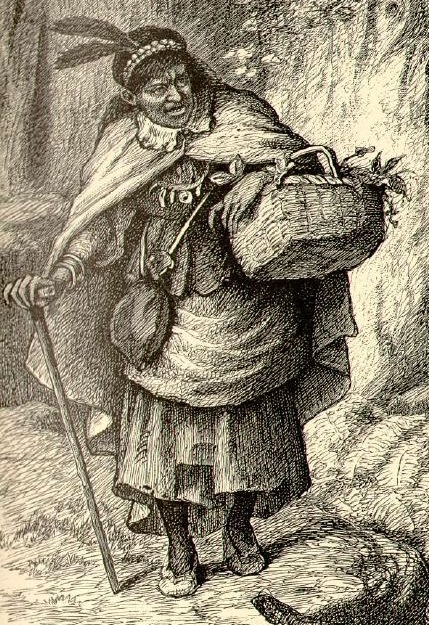
In villages, there were wise men and wise women. Most could not read and they learned their craft by word of mouth, from a family member or a mentor. They made charms, healed sick cattle, used herbal remedies and recited simple spells.
There were also healers known as root-cutters, who specialised in gathering and preparing herbs, both medicinal and poisonous. They often combined the herb with a spoken or written charm, which made the cure seem more magical than medical, at least to modern eyes.
These healers had many customs around collecting plants. Some left offerings in the place where they had taken a plant. Some harvested only at night. They paid attention to the stars. Today, these habits might look like superstition. But they came from a long religious tradition in which nature itself is seen as sacred and gathering a plant becomes a kind of religious act.
For the Greek philosopher Plato, nature was alive, and plants were linked to the stars and planets. Because of this connection, plants were used to cure illness and to make protective charms.
But that same knowledge carried a risk. A healer who knew which plants could cure also knew which plants could kill. Over time, this knowledge of poisonous plants helped blur the line between herbalists and witches.
Fennel, the protector
Not every plant in “witch history” was associated with harm. One of the most interesting is fennel, an aromatic plant that is both edible and medicinal.
In ancient Greece, fennel was linked to Dionysus, the god of wine and nature. His followers carried stalks of fennel in their rituals. Plato even remarked, “Many are the fennel-bearers, but few are the mystics,” to illustrate a philosophical truth about wisdom and true understanding.
Centuries later, fennel reappears in a very different context. In Friuli, a mountainous region in northern Italy, there existed a population known as the benandanti. Comprising mostly men and a few women, they were distinguished by being born with the caul, a thin layer of the birth sac still wrapped around them, which many believed to be a sign of good luck.
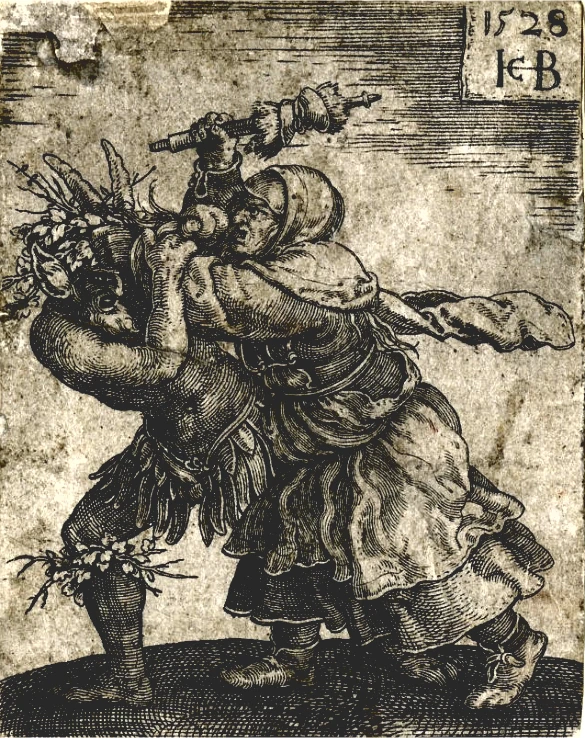
The benandanti believed they were chosen to protect the harvest and ensure the fertility of the fields. On specific Thursday nights, they would fall into a trance, their spirits flying out to battle witches. Their weapon of choice was a bundle of fennel stalks.
However, their story took a dark turn. When the Roman Inquisition first learned of the benandanti in 1575, it initially dismissed their accounts as too bizarre to be credible. Yet, over time, the inquisitors gradually reinterpreted these stories to align with their own preconceived notions of witchcraft. By 1634, the Holy Office had transformed these fennel-wielding defenders into witches themselves, accusing them of gathering at the sabbat.
The flying ointments
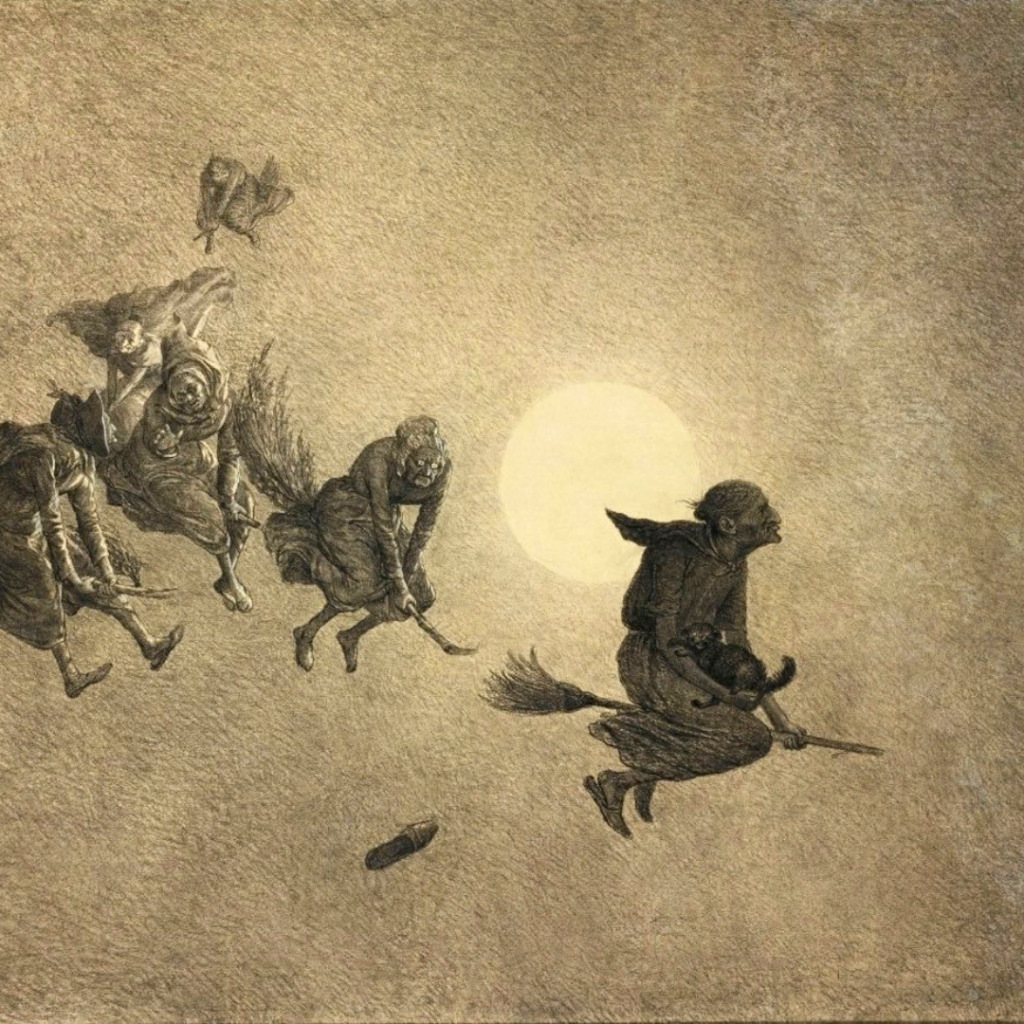
During the witch trials, people debated how witches traveled to their secret night meetings, called sabbats. Many writers claimed that special ointments, smeared on the body or on the stick the witch rode, aided the journey. Five plants were often named as ingredients: hemlock, nightshade, belladonna, mandrake, and henbane.
Several of these plants belong to the nightshade family and contain a substance that can cause hallucinations. However, they are also highly poisonous and can be fatal.
Historians have long debated the nature of these ointments. Some, writing in the 1960s and 1970s, suggested that witches’ tales of flying originated from the use of these plants. Later historians disagreed, arguing that the “flying ointments” were largely an invention of demonologists. These writers believed the ointment’s power came from the Devil, rather than from any inherent property of the plants themselves.
A recent historian, Edward Bever, has suggested these drugs may have been part of folk medicine, given that some of the accused named herbs that could cause hallucinations.
REFERENCE
Timbers, F., 2019. A History of Magic and Witchcraft: Sabbats, Satan & Superstitions in the West. Pen and Sword.
Leave a Reply