
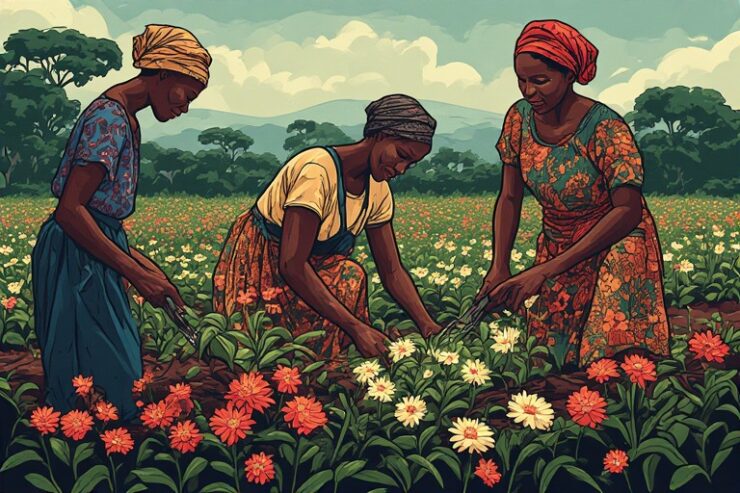
Behind every flower bouquet is a story most people never see. A story of environmental destruction and worker exploitation that runs deeper than you imagine.
CUT FLOWER INDUSTRY OF SUB-SAHARAN AFRICA
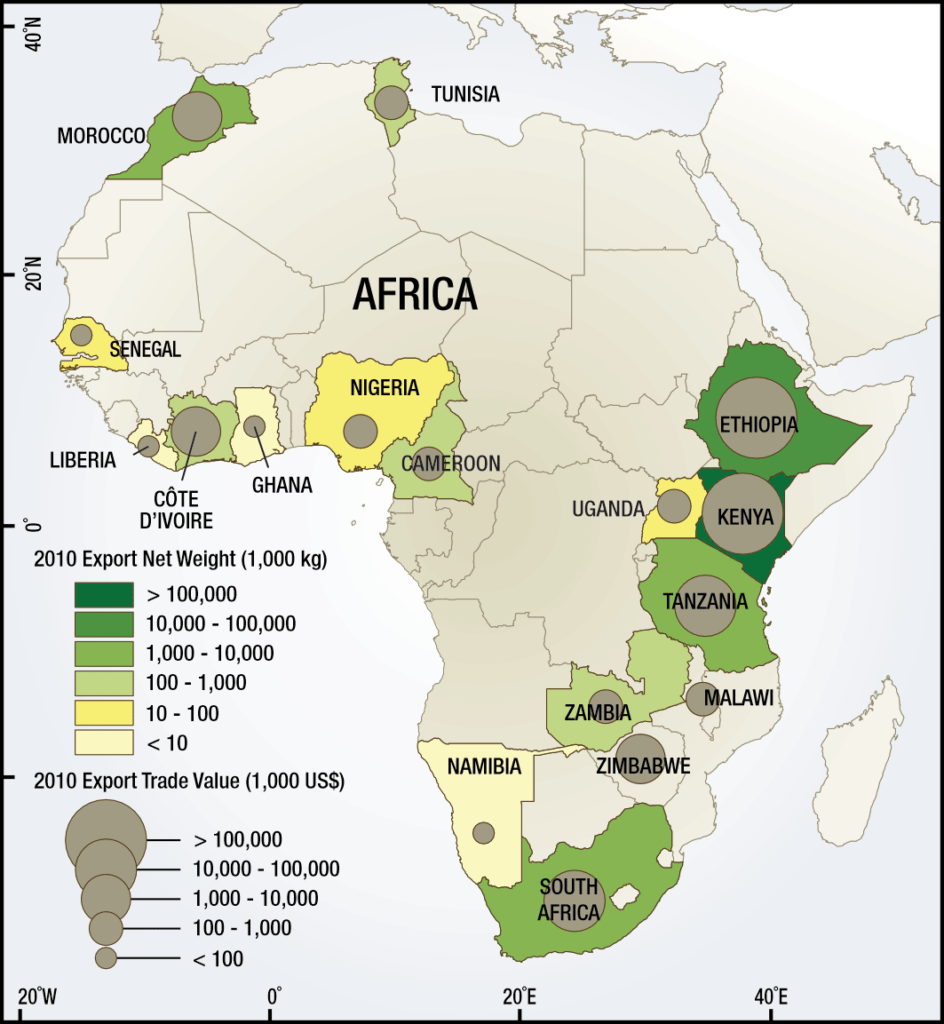
Sub-Saharan Africa is a major supplier in the global cut flower trade, accounting for 17% of all flowers traded worldwide. The regional industry is valued at $1.4 billion annually. Kenya is the continent’s leader, now supplying over 16% of global rose exports. Together with Ethiopia, these two countries export flowers worth nearly $900 million each year, mainly to markets in Europe and the Middle East.
BLATANT CHEMICAL USE
In Ethiopia, researchers found about 156 different chemical and pesticides types being used on flower farms in just one district. Two of them, namely Impulse and Meltatix are banned by the World Health Organization. Yet they’re being sprayed on flowers destined for dining tables and bedside tables around the world.
These chemicals cause cancer, birth defects, reproductive damage, nervous system damage. And the Workers are exposed at every stage, i.e, planting, growing, cutting, packing, meaning the health risks are constant and unavoidable.
WATER POLLUTION
In Ethiopia’s Wolmera district, flower farms use about 30,000 cubic meters of water per hectare. They discharge 7,200 cubic meters of wastewater (loaded with pesticides and fertilisers) back into the environment every year.
In Kenya, cut flowers account for 45 percent of the country’s virtual water exports. Over half of the water drawn from Lake Naivasha, an essential freshwater source, is designated for the floriculture industry.
GREEN HOUSE GAS EMISSIONS
Farms contribute to greenhouse gas emissions in the atmosphere. In Ethiopia, burning leftover plant material on farms releases over 7 gigagrams of CO2 annually, along with nitrous oxide and methane.
Additionally, the application of fertilisers, reportedly 650 kilograms of diammonium phosphate and 450 kilograms of urea per hectare each year, further increases emissions. Notably, the nitrous oxide produced from these fertilizers has a global warming potential that is 310 times greater than that of CO2 over a hundred-year period.
CHALLENGES FACED BY THE WORKERS
Women make up 56-75 % of the flower workforce, with variations depending on the region. During peak seasons, such as Valentine’s Day and Mother’s Day, workers are often required to take double shifts, working twelve to sixteen hours a day or even longer, all while being closely monitored to ensure high productivity. The pressure associated with Valentine’s Day permeates the entire supply chain weeks in advance. This leads to a feast-or-famine cycle. Gruelling hours during peak times followed by periods of underemployment or complete job loss when demand decreaes. There is no stability or security, only persistent uncertainty.
Many of the pesticides used are neurotoxicants that directly harm the nervous system. Workers are exposed to chemicals such as carbendazim, mancozeb, and thiram, all of which are confirmed or suspected neurotoxins. These substances can cause headaches, dizziness, and long-term cognitive impairment. Research indicates that pesticide exposure also affects the children of these workers, impacting their mental and neurophysical development. This damage can extend beyond a single generation, perpetuating a cycle of harm.
The wages make everything worse. In Kenya, workers earn about €895 per year in base salary. The living wage benchmark is €2,808. Less than a third of what they need to live with dignity, ensuring that even full-time work keeps them trapped in poverty.
POINTS TO PONDER
The flower industry however, does provide essential employment. In Kenya alone, 130,000 to 150,000 direct jobs. Similar numbers in other producing regions. For many families, this is the only income source available.
The solution isn’t shutting down the industry. It’s demanding fundamental, systemic change.
Stronger environmental regulations that actually stop banned pesticides from being used. Human rights laws with real enforcement, not just paperwork. A shift to safer chemicals. Wages that cover the actual cost of living. The right to form unions. Real health protections for workers, including support for mothers and mental health care.
Without these changes, the industry will keep growing beautiful flowers while destroying the environment and the people who grow them.
REFERENCES
Defar, A., & Ali, A. (2013). Occupational induced health problems in floriculture workers in Sebeta and surrounding areas, West Shewa, Oromia, Ethiopia. Ethiopian Journal of Health Development. https://doi.org/10.4314/EJHD.V27I1
Depression, Anxiety, and Coping Strategies Among Farmworkers … (2024). https://www.tandfonline.com/doi/full/10.1080/1059924X.2024.2407384
Every rose has its thorn – the true cost of unethical flowers on … (2025). https://www.fairtrade.net/en/get-involved/news/every-rose-has-its-thorn-true-cost-of-unethical-valentines-flowers.html
Hanssen, V. M., Nigatu, A., Zeleke, Z., Moen, B., & Bråtveit, M. (2015). High Prevalence of Respiratory and Dermal Symptoms Among Ethiopian Flower Farm Workers. Archives of Environmental & Occupational Health. https://www.semanticscholar.org/paper/91a17030fcf37f8fb7dc2abec6d49a52f43175ff
[PDF] An Assessment of Workers’ Rights in Three Floriculture Industries. (2014). https://etd.aau.edu.et/bitstreams/e1969d8e-a03d-4936-9d2f-bc0c9fe023a7/download
The dark side of the flower sector: the growing exploitation of women … (2022). https://www.antislavery.org/latest/flower-sector-exploitation-of-women-in-kenya/
Leave a Reply